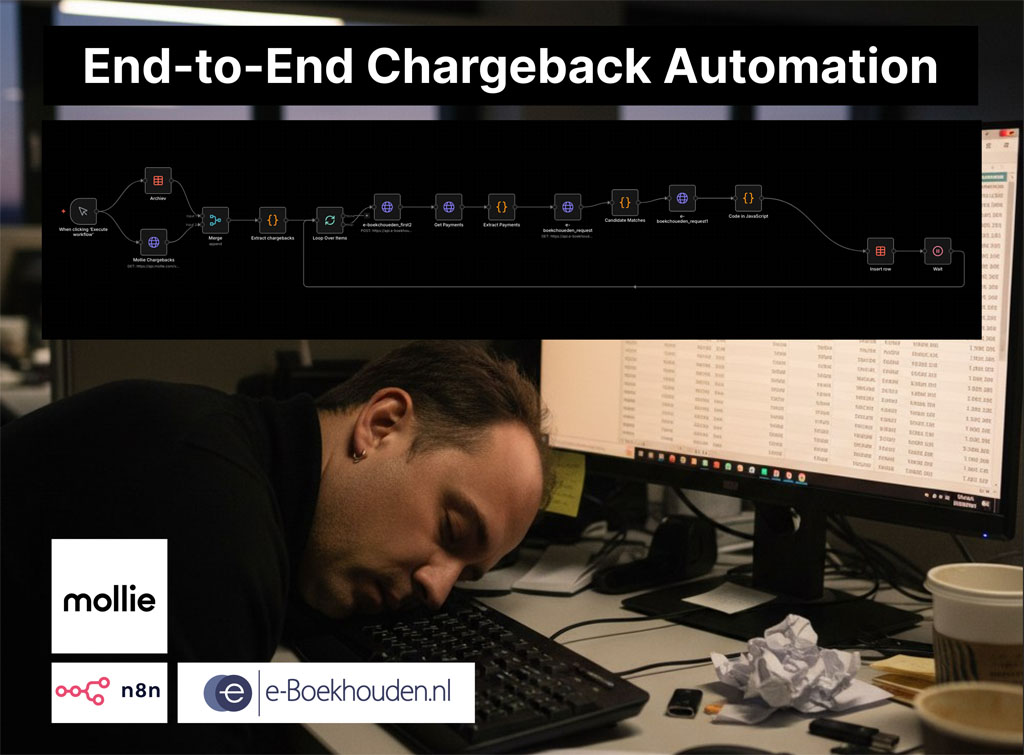
End-to-End Chargeback Automation for Mollie and e-Boekhouden
Case summary
Quick scan before the full breakdown.
Goal
Automate chargeback matching and closing mutation creation between Mollie and e-Boekhouden
Stack
n8n, Mollie API, e-Boekhouden API, JavaScript, Data Tables
Result
99% matching accuracy and 90% of chargeback handling automated
Time saved
Reduced processing from about 15 minutes per case to seconds
The client was handling chargebacks manually between Mollie and e-Boekhouden.
That meant checking dates, scanning transactions without proper filters, opening entries one by one, and manually matching them to payments.
I turned that into a full n8n system that identifies the correct payment, finds the right bank mutation, and creates the corresponding accounting mutation automatically.
The result is an end-to-end workflow with minimal human involvement.
The goal
The client needed to eliminate manual chargeback processing.
Each case could take up to 15 minutes and required careful validation:
- finding the original payment
- locating the corresponding bank mutation
- verifying the amount
- confirming the order reference
The main challenge was that e-Boekhouden does not provide sufficient filtering at the mutation level.
That meant the accountant had to manually search through transactions within a date range and rely on experience to identify the correct match.
So the task was not just to connect APIs.
The real task was to replicate the human decision-making process and automate it with high accuracy.
What I built
1. Chargeback intake and deduplication
The workflow retrieves chargebacks from Mollie and checks them against an internal archive of already processed records.
This prevents duplicate processing and ensures only new chargebacks enter the pipeline.
All relevant fields are normalized, including IDs, amounts, currency, dates, settlement status, reasons, and links.
2. Payment enrichment layer
For each chargeback, the workflow retrieves the original payment and extracts key data such as amount, currency, payment dates, description, and order identifiers.
The order number is extracted both from metadata and by parsing the payment description.
I also implemented a dynamic date search window of plus or minus several days to account for delays between payment events and accounting entries.
3. Bank mutation search across multiple dates
Since filtering in e-Boekhouden is limited, I replicated the manual search logic programmatically.
The workflow queries mutations for each date within the search window and collects all relevant bank entries.
This replaced manual transaction browsing with a structured candidate selection process.
4. Match scoring engine
I implemented a custom JavaScript scoring system to determine the best match.
It evaluates:
- presence of the order number in descriptions
- exact amount match
- matches within mutation row descriptions
Each candidate receives a score and is classified as:
- exact match
- strong match
- weak match
- no match
5. Best-match selection and database storage
When multiple candidates exist, the system selects the one with the highest score.
The results are then stored in a Data Table, including:
- chargeback ID
- payment ID
- order number
- matched mutation ID
- match score and reasons
- amounts, dates, and statuses
This creates a single source of truth for further automation.
6. Second workflow: automatic mutation creation
I built a second workflow that uses the stored matches to automatically create closing mutations in e-Boekhouden.
This separation ensures:
- the first workflow handles matching and validation
- the second workflow executes accounting actions
As a result, the system remains both automated and controlled.
7. Process visibility and control
The system tracks operational fields such as:
- settlement status
- reversal status
- whether a compensation mutation was created
- processing errors and notes
This provides full transparency and control over the process.
System architecture
The solution is built in n8n and consists of two connected workflows: one for matching and one for execution.
Core components:
- n8n for workflow orchestration
- Mollie API for chargebacks and payments
- e-Boekhouden API for mutations and sessions
- JavaScript Code nodes for parsing, logic, and scoring
- Data Tables for storage and process tracking
- batch processing plus wait logic for safe sequential execution
Results
The automation completely transformed the chargeback handling process.
Outcomes:
- 99% matching accuracy
- 90% of the process fully automated, including mutation creation
- most chargebacks are resolved without accountant involvement
- processing time reduced from about 15 minutes to seconds
- scalable and reliable system replacing manual work
Related thinking: Chargebacks Should Not Be Manual, Faster, but broken, is still broken, and The system broke the moment we launched it.
More cases
Three nearby case studies worth reading next.
Aug 22, 2026
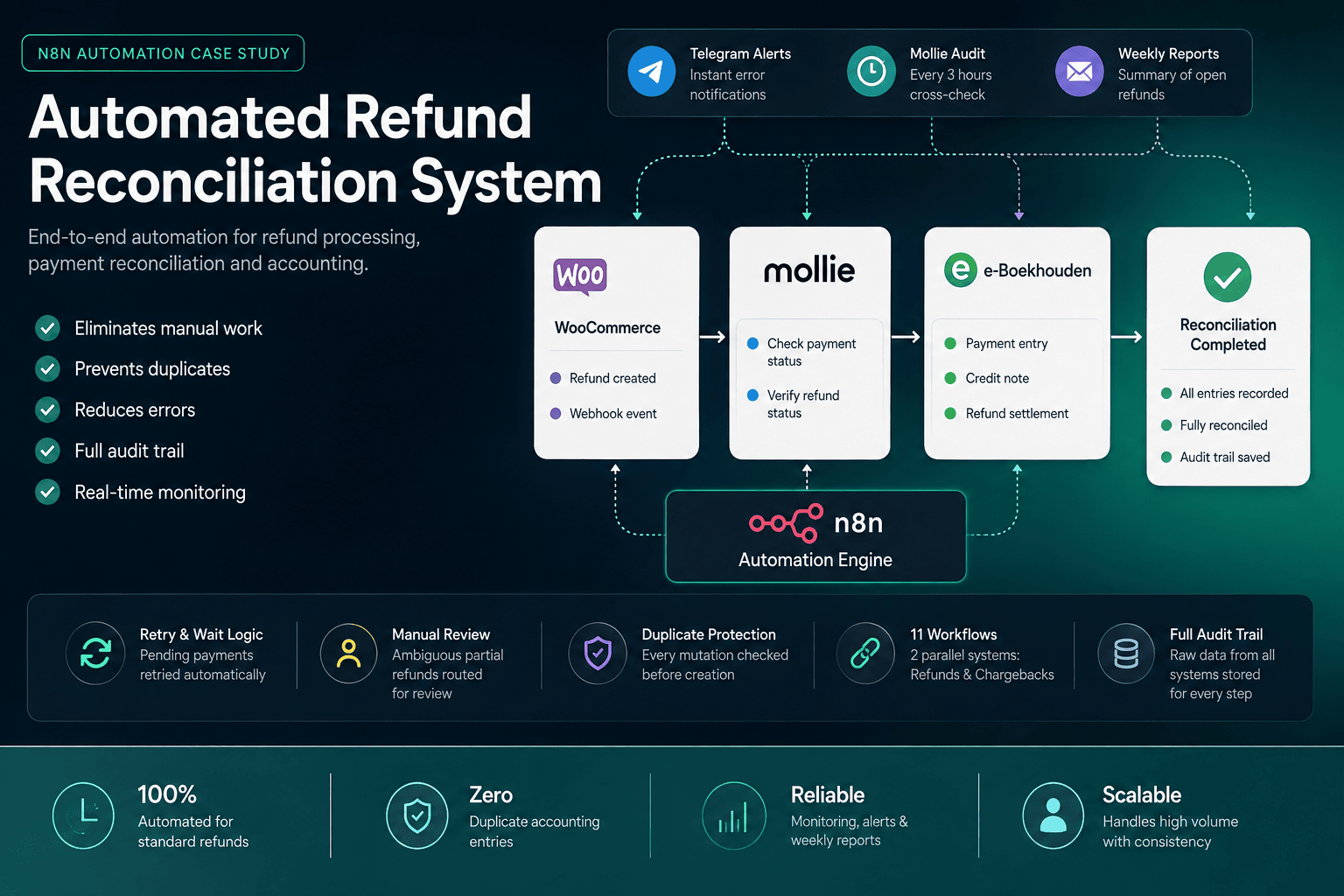
Automated Refund Reconciliation System for WooCommerce & Mollie
An 11-workflow n8n system that reconciles refunds across WooCommerce, Mollie and e-Boekhouden, with duplicate protection, retries, an independent audit, and alerts.
Apr 2, 2026
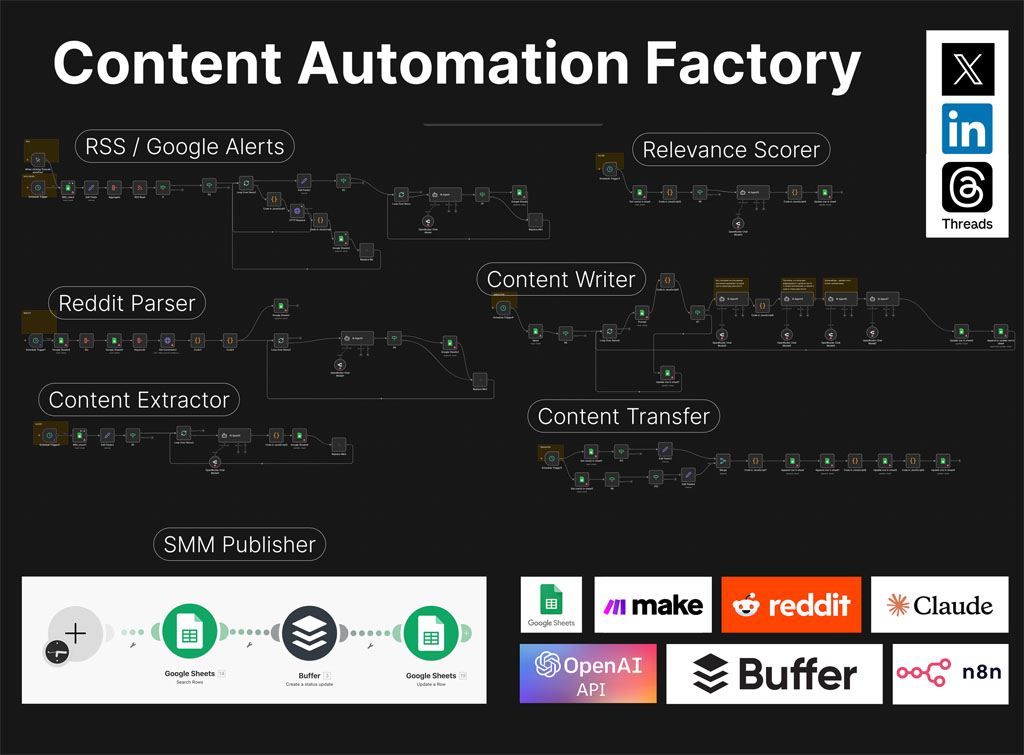
n8n Pipeline for AI News to LinkedIn, X, and Threads Posts
An n8n pipeline that scores AI news and drafts social posts — and what it took (and mostly didn't work) to stop the drafts sounding like AI.
Apr 10, 2026
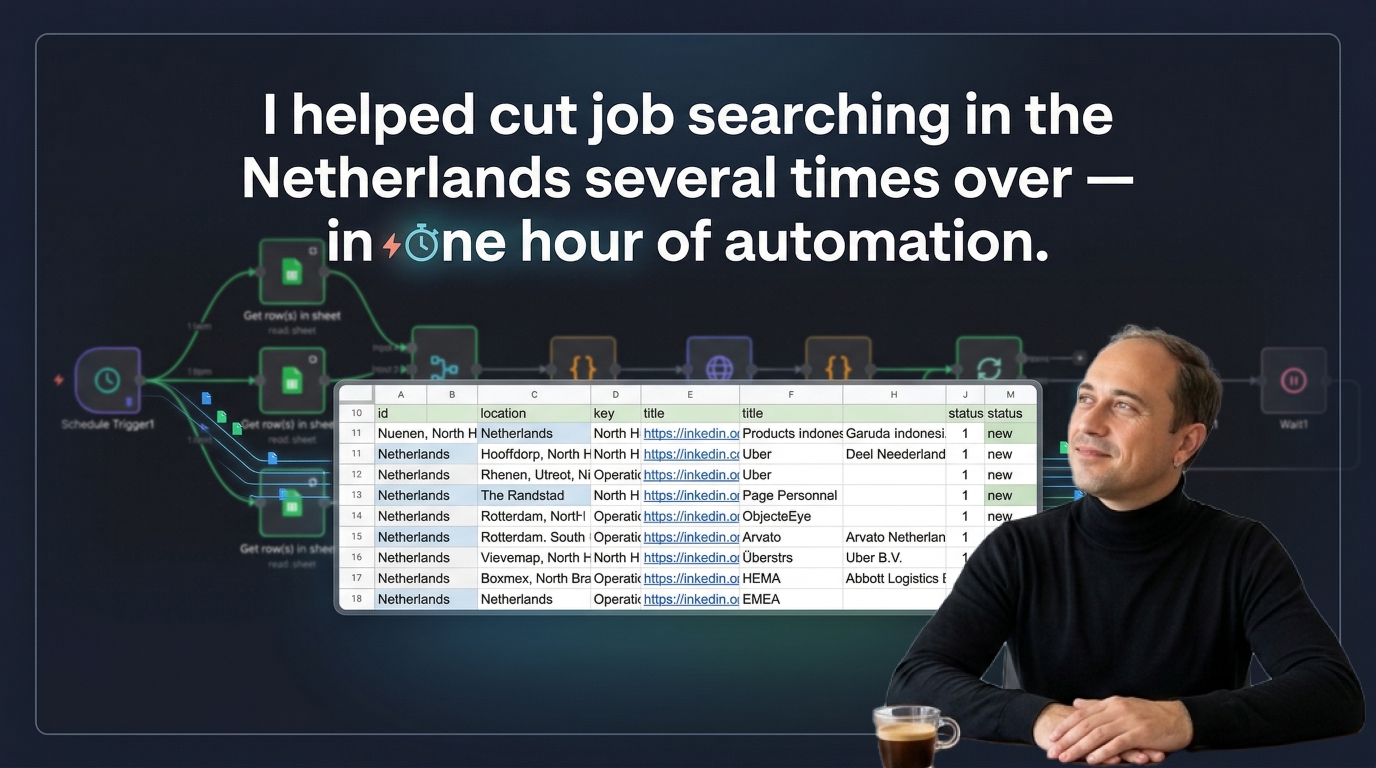
Telegram Job Search Bot for Sponsor-Friendly Roles in NL
An n8n workflow that searches fresh LinkedIn vacancies, checks companies against the IND sponsor register, and writes application-ready leads into Sheets.