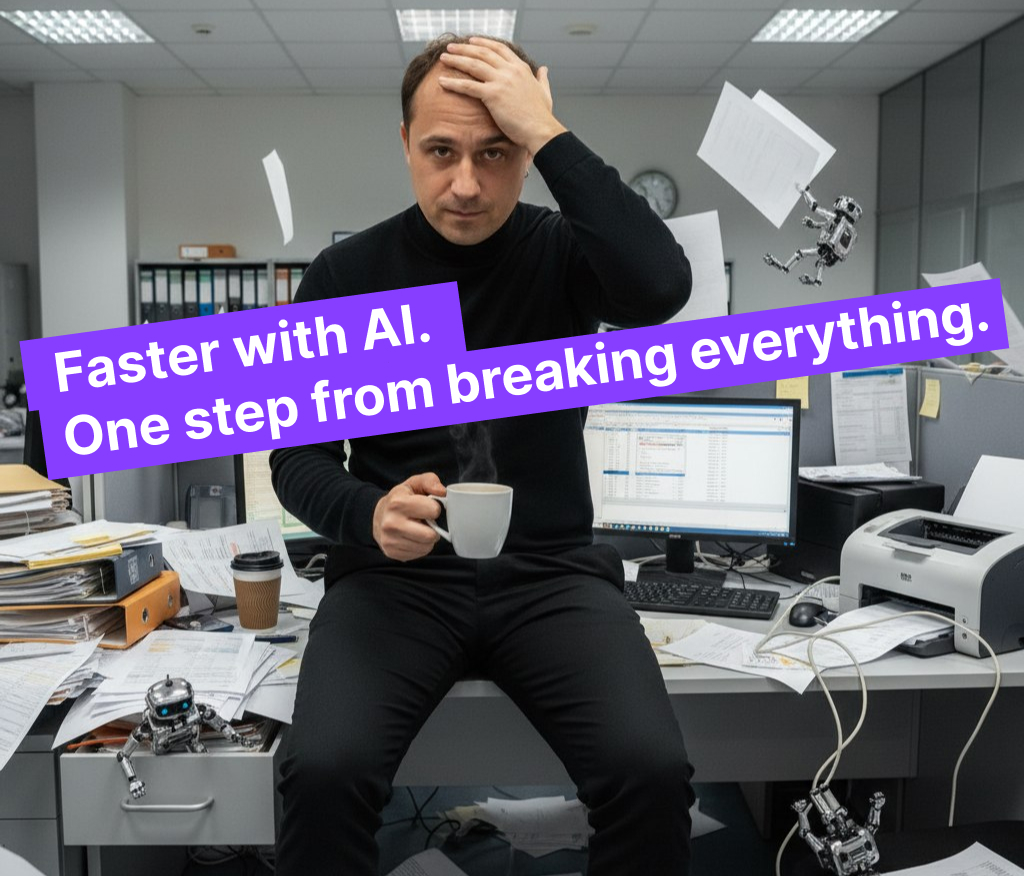
Faster, but broken, is still broken.
AI agent cut my working time in half. But without a human, it would have broken the entire system.
I was building an automation: WooCommerce → Mollie → E-boekhouding. The task looked simple — customer returns a product, status changes, a chain of actions kicks off. In practice — total uncertainty: which mutations in EPR were already created manually, which weren’t, and what a “correct” refund processing even looks like.
After doing chargebacks completely by hand, I wanted to speed things up — so I brought in the Codex CLI agent (by the way, I’ve heard it’s smarter than Claude Code — is that actually true?). We worked together: querying data, analyzing fields, figuring out what to look for and where. Not “write me a workflow” — more like a joint investigation of the system.
What happened:
→ Time cut in half → Agent built a working workflow → During testing I realized — run it without review, and it would create hundreds of duplicate mutations that could only be cleaned up manually What saved me: I already knew the database structure from the previous workflow. I could see when the agent was going off track and course-corrected deliberately. Without that context — I would have trusted it and ended up with a mess.
The final solution was also mine: create the old mutations manually one time, route all new refunds through the new automated path. Simple, clean, works. AI agents speed things up. But in processes where a mistake means hours of manual cleanup, they don’t replace expertise — they amplify it. You need a human who understands the system to steer the wheel.
And by the way — if you need something like this, you know who does it.
Read next
Three nearby posts worth opening next.

Apr 17, 2026
These support bots drive me crazy.
A simple phrase often pushes automated support chats to a human, which says a lot about how fragile emotion-based escalation really is.

Apr 19, 2026
The system broke the moment we launched it.
A refund automation failed because it ran faster than the accounting system's settlement window — the fix was a simple age check before processing.

Apr 4, 2026
Chargebacks Should Not Be Manual
I traced a chargeback workflow from Mollie to e-Boekhouden by hand, then turned that logic into an n8n workflow that closes most cases automatically.