AI Lead Generation and Outreach Automation System
Case summary
Quick scan before the full breakdown.
Goal
Automate prospecting from lead collection through qualification and outreach draft generation
Stack
n8n, Slack, Airtable, OpenStreetMap, Google Maps API, OpenAI, Claude
Result
1,300 leads collected and qualified with personalized outreach drafts generated automatically
Time saved
Approximately 90 to 100 hours saved for a 1,300-company dataset
My role: Automation Architect & Engineer
Designed and built an end-to-end lead generation and outreach system controlled via Slack.
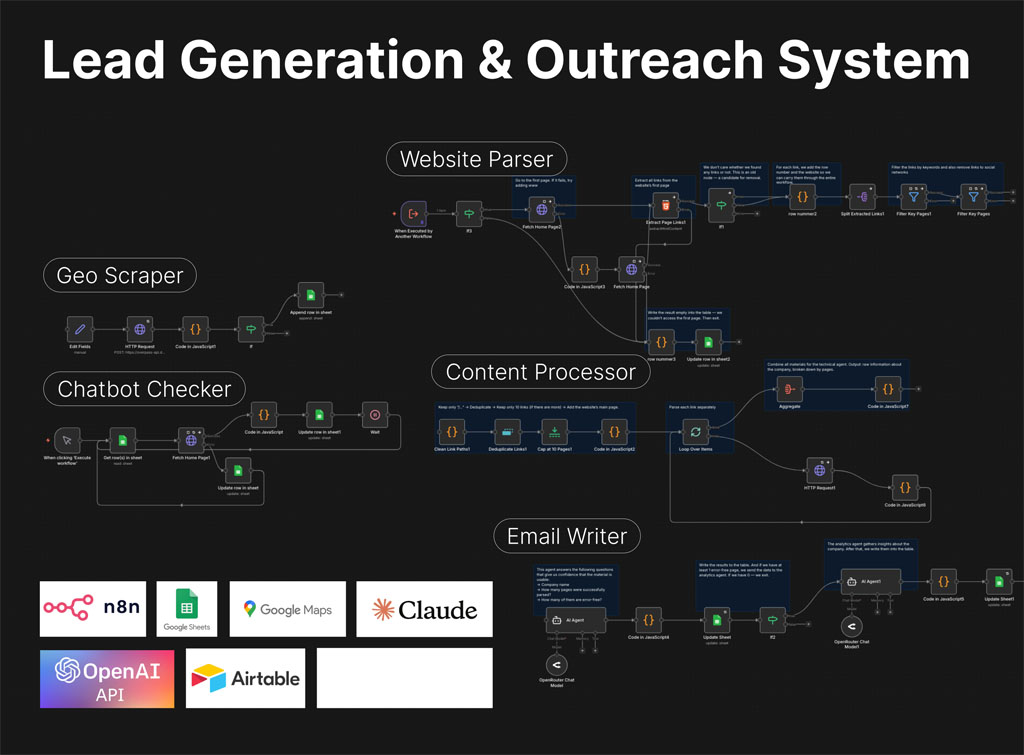
The system collects business leads from multiple sources, analyzes their websites, qualifies opportunities, and generates personalized outreach emails.
The full workflow is automated with minimal manual involvement, while still giving the user control and visibility through a simple Slack interface.
Tools and deliverables
- Airtable
- Slack
- OpenStreetMap
- Google Maps API
- Email outreach automation
The goal
The objective was to automate the full prospecting workflow:
- collect business leads from different sources
- identify relevant companies
- analyze their websites
- generate personalized outreach emails
The focus was on replacing repetitive manual work such as research, analysis, and drafting with a structured and reliable system.
What I built
1. Lead collection from multiple sources
I implemented two independent lead collection workflows:
- OpenStreetMap scraping
- Google Maps lead extraction via Outscraper API
The system extracts:
- company name
- website
A live run produced 1,300 restaurant leads in Amsterdam.
2. Chatbot detection
I built a workflow that analyzes each website and detects:
- whether a chatbot is present
- what type of chatbot is used
This makes it possible to identify companies that are more relevant for outreach.
3. Website parsing
I created a dedicated workflow that processes selected leads and:
- visits each website
- extracts page content
- finds available email addresses
- prepares structured data
4. Content processing
I implemented a content processing workflow using a cost-efficient OpenAI model.
It:
- cleans and structures website content
- extracts key business information
- prepares input for email generation
5. AI email generation
I built a personalized email generation pipeline:
- OpenAI is used for preprocessing
- Claude is used for final email writing
Emails are:
- based on actual website content
- personalized
- written in a natural tone without templates
6. Lead qualification and storage
All leads are stored in Airtable in the production version of the system.
Tracked fields include:
- company
- website
- chatbot status
- processed content
- lead score
- outreach status
Leads are scored, and only qualified entries proceed to email generation.
Slack control interface
The system is fully controlled via Slack.
A typical flow looks like this:
- The user sends a request such as “Find restaurants in Amsterdam”.
- The system triggers the workflows automatically.
- Processing runs in the background.
- When finished, Slack returns: “Completed. Results are available in Airtable.”
This removes the need to interact with n8n directly and makes the system usable for non-technical users.
System architecture
The solution is built as a set of modular workflows:
- lead collection
- chatbot detection
- website parsing
- content processing
- email generation
The workflows are independent and synchronized through lead status in Airtable.
This ensures:
- stability
- no duplicate processing
- clear visibility of progress
Results
The system delivered a fully working lead generation and outreach workflow.
Outcomes:
- collected 1,300 business leads from Amsterdam restaurants
- automatically analyzed websites and detected chatbot presence
- extracted content and contact data
- assigned lead scores
- generated personalized outreach emails
Estimated time saved
For a dataset of 1,300 companies, the system saves approximately 90 to 100 hours of manual work.
This replaces:
- manual lead search
- website review
- chatbot checks
- contact extraction
- content analysis
- initial email drafting
Related thinking: AI in Lead Gen Is a Detective explains the lead-response problem behind this build.
More cases
Three nearby case studies worth reading next.
Apr 2, 2026
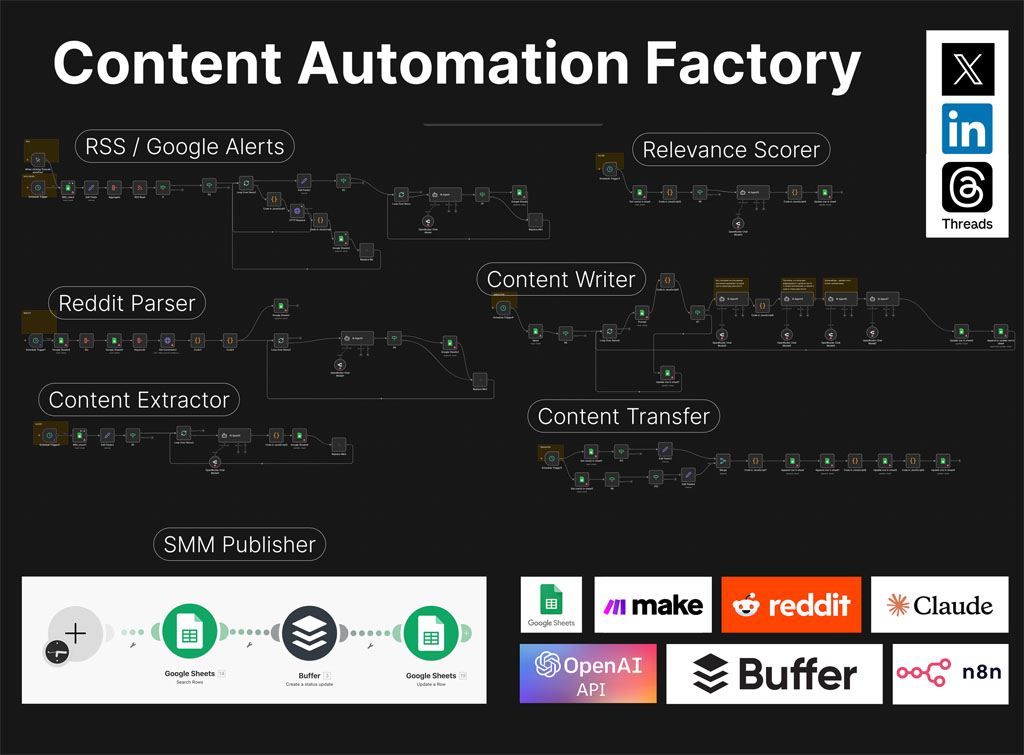
n8n Pipeline for AI News to LinkedIn, X, and Threads Posts
An n8n pipeline that scores AI news and drafts social posts — and what it took (and mostly didn't work) to stop the drafts sounding like AI.
Aug 4, 2026
1,000-Lead Cold Outreach System: Outscraper, Zoho CRM, Claude Code
An end-to-end B2B outreach pipeline that sources, scrapes, classifies and sequences leads automatically, from Google Maps to a personalised first email.
Aug 10, 2026
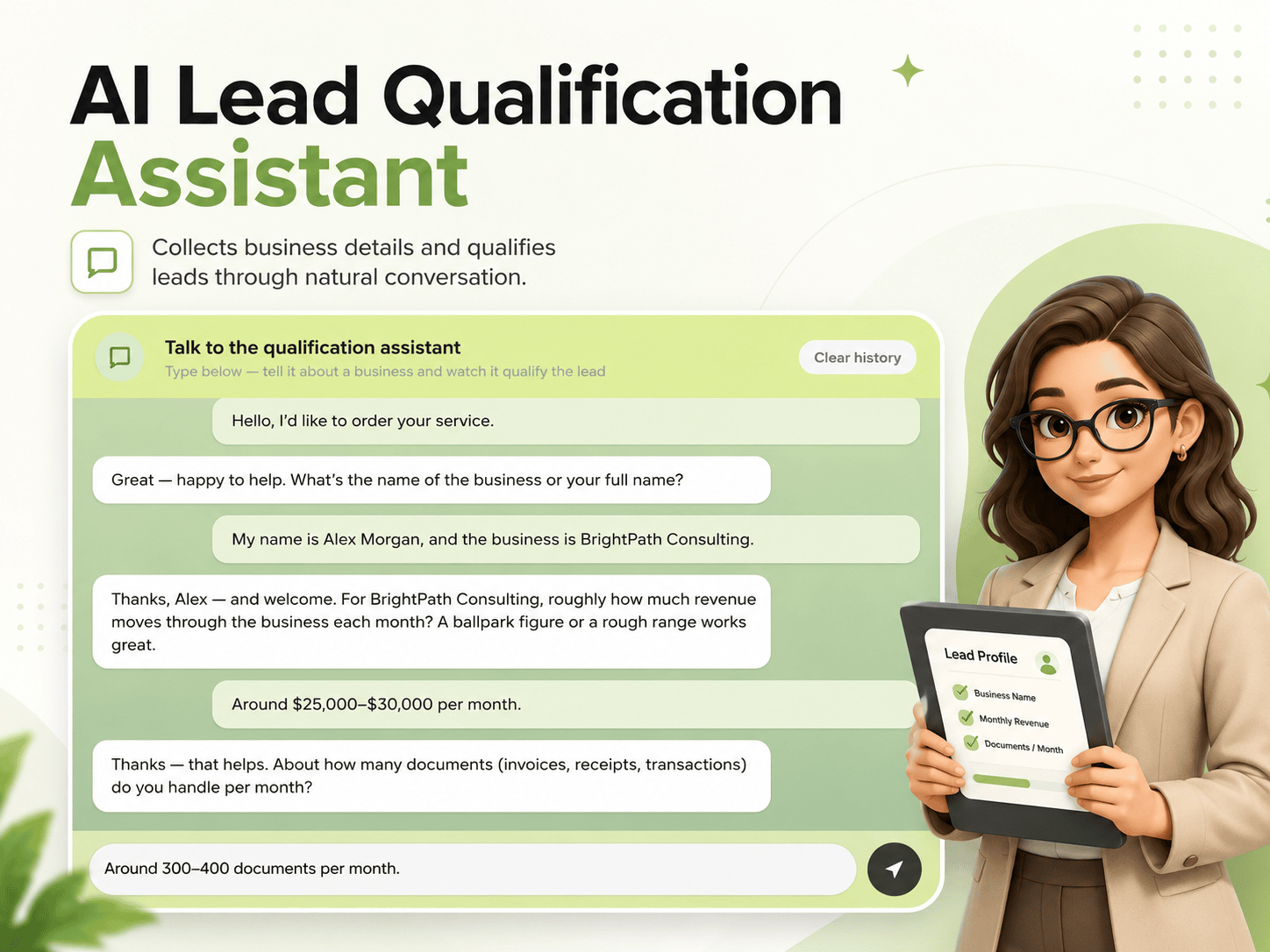
AI Lead Qualification Assistant with Live Scoring (n8n)
A conversational n8n assistant that qualifies leads for a bookkeeping firm, scores them against admin-editable thresholds, and starts fresh for every new conversation.