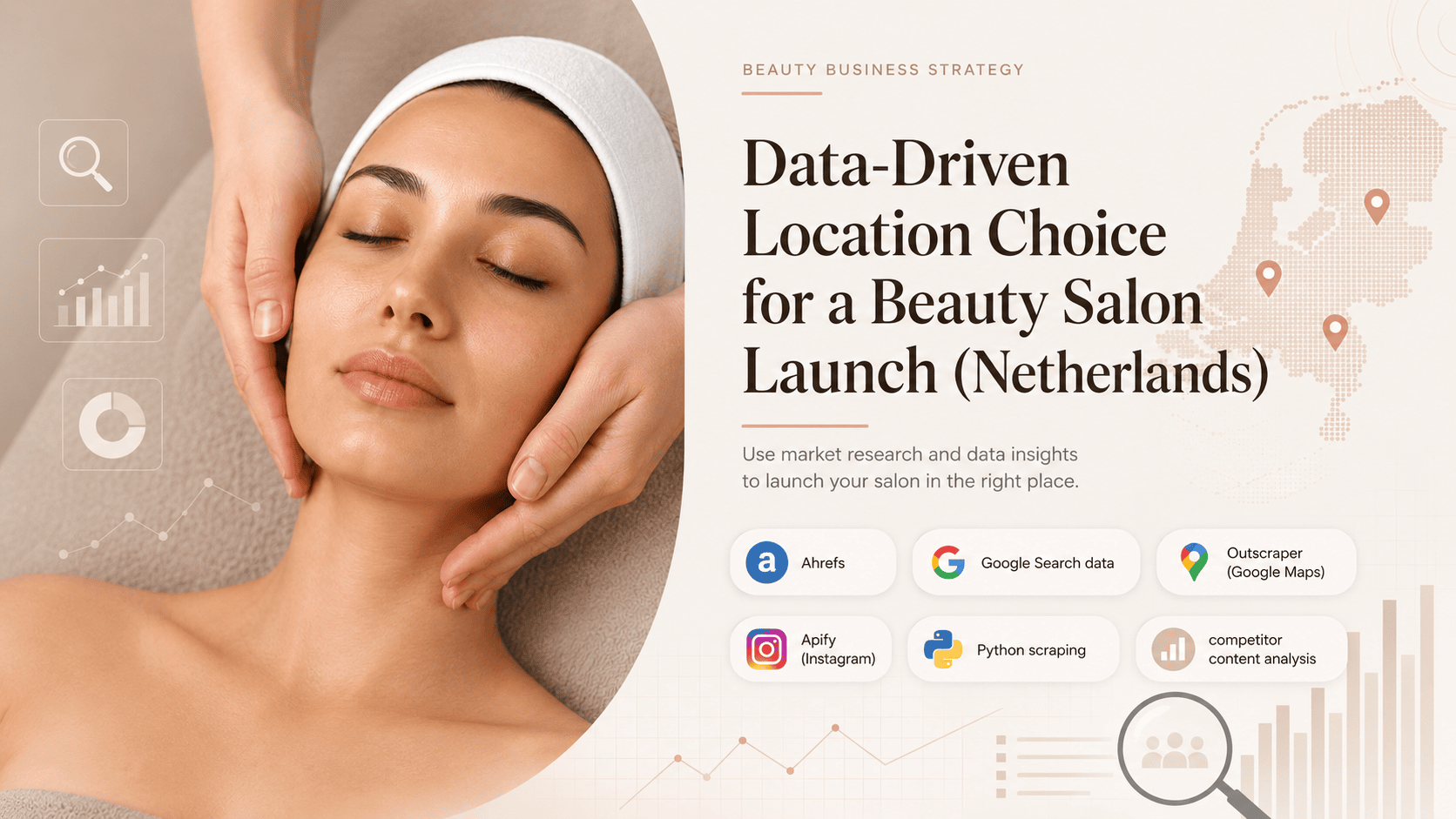
Data-Driven Location Choice for a Beauty Salon Launch (Netherlands)
Case summary
Quick scan before the full breakdown.
Goal
Choose the right Dutch city to open a beauty salon based on real search demand and competition, not intuition
Stack
Ahrefs, Google Search data, Outscraper, Apify, Python scraping
Result
Identified Almere as the best demand-to-competition ratio, after data ruled out the two cities she was actually considering
A cosmetologist was about to sign a lease in Urk before knowing whether anyone there searched for her services.
She had picked Urk because that’s where she lived. Amsterdam came up as an alternative, mostly because it’s Amsterdam. She was ready to rent a treatment room on the basis of intuition and proximity.
The real question was never “which room.” It was: in which city do enough people actually search for these specific procedures, and how crowded is that city already? That question has a data answer. Most people opening a small business never ask it.
I replaced the guess with data: Ahrefs for real search demand per city, Outscraper for every competing salon on Google Maps, Apify for competitors’ full Instagram archives.
What I did
1. Demand measurement
Ahrefs and Google search data, procedure by procedure, city by city. Not “beauty salon” in general — the exact treatments she offers, in Dutch, with local phrasing. Search volume is the closest honest proxy for whether a market exists before you’ve spent a euro on rent.
2. Supply mapping
Outscraper pulled every competing salon from Google Maps in each candidate city: locations, ratings, review counts, websites. Demand without a competition count only tells half the story.
3. Competitor deep-dive
A scraper collected competitor websites, and Apify pulled complete Instagram archives — posts, captions, formats, posting cadence. This produced three things at once: a realistic price range, the visual language Dutch clients respond to, and the tone local salons actually use.
What the data said
- Urk — near-zero search volume for her procedures. Not surprising for a town that size, but it would have been an expensive lesson to learn after signing a lease.
- Amsterdam — strong demand, heavy saturation. A new practice with no reputation would be competing on ad spend from day one.
- Almere — the best ratio of the three. Real demand, competition thin enough to enter. This is where she opened.
What came next
The competitor dataset stayed useful long after the location decision. Pricing was set against a real observed range. The website and Instagram account were built to read as Dutch-local — tone, structure, and content formats all drawn from what already works in this market. An SMM specialist was brought in to run the account against that brief.
Why this matters
The automation here wasn’t a workflow that runs forever. It was applied at the one moment where being wrong is most expensive: choosing where to plant a business. Data collection that takes a few days can prevent a year of paying rent in a city where nobody is looking for you.
Stack
Ahrefs, Google Search data, Outscraper (Google Maps), Apify (Instagram), Python scraping, competitor content analysis.
More cases
Three nearby case studies worth reading next.
Aug 4, 2026
1,000-Lead Cold Outreach System: Outscraper, Zoho CRM, Claude Code
An end-to-end B2B outreach pipeline that sources, scrapes, classifies and sequences leads automatically, from Google Maps to a personalised first email.
Aug 24, 2026
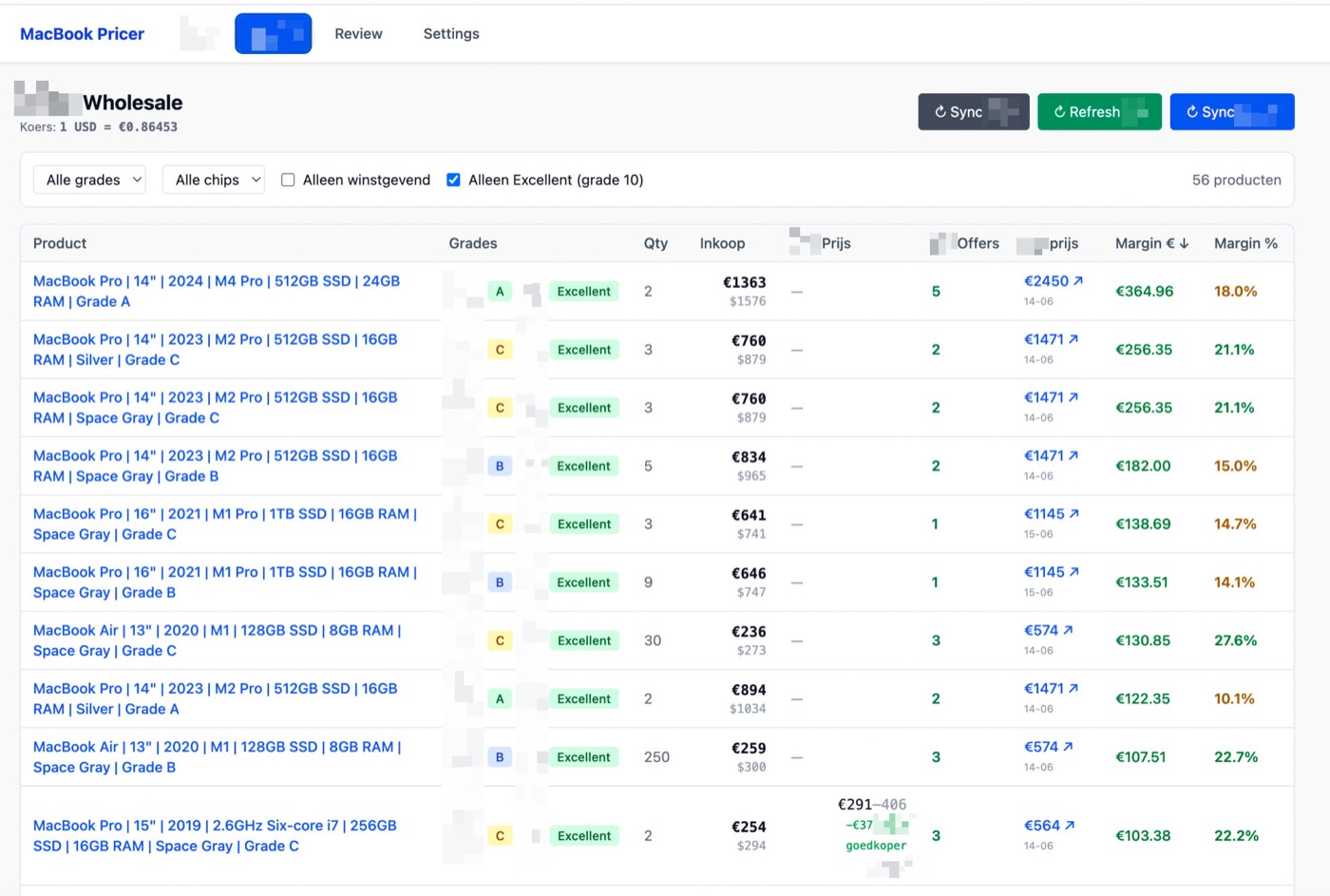
MacBook Price Comparison and Resale Margin Tracker
A private FastAPI and n8n system that compares MacBook offers across three sources, one sitting behind Cloudflare, and ranks the resale margin gaps worth acting on.

Aug 10, 2026
AI Lead Qualification Assistant with Live Scoring (n8n)
A conversational n8n assistant that qualifies leads for a bookkeeping firm, scores them against admin-editable thresholds, and starts fresh for every new conversation.