
The Most Expensive Sentence in a Startup
Every month someone tells me:
“We’re almost ready. Just a few more things to fix, then we’ll go to market.”
That is the most expensive sentence in a startup.
I went through 10 European companies, from Denmark’s Too Good To Go to Germany’s n8n, trying to understand what actually worked at the very beginning.
Before the money. Before the hype.
Here are three things we almost never talk about over coffee.
1. Your first channel is not ads. It is 50 personal messages
Belgium’s Tally hit $5K MRR in their first year without running campaigns.
The founders built a list of people who had commented on similar products and wrote to each one personally.
Not “buy this.”
More like: “Help us understand if we’re thinking about this right.”
Boring. Works.
2. “We’ll launch and see” is not a strategy. It is a prayer
French lemlist sold $170K in two weeks, not because they got lucky, but because they had built a community of 800 people who were already waiting.
Monzo launched to a waitlist of 20,000 before the product was ready.
First traction is built before launch, not after.
3. If your product leaves no free trace, you pay for every customer twice
Bulgaria’s Checkout X got 40% of customers through affiliates who used the product themselves.
n8n hit 10,000 GitHub stars in 5 months by going open source.
Tally put a badge on every free form.
These are not growth hacks. They are distribution channels baked into the product.
Three questions worth answering before launch
I am not saying you need to do all of this at once.
I am saying that before launch, three questions are worth answering:
- Do I have 50 people I can write to personally, not to announce, but to actually talk?
- Do I know exactly what happens in the first 24 hours after launch, and who will see it?
- Is there something in the product that brings the next user without my involvement?
If even one of those has no answer, that is the real gap to close before you ship.
Not a feature.
Not the design.
Not just a little more polish.
What drove your first traction?
What worked, and what did you burn time on for nothing?
Read next
Three nearby posts worth opening next.

Sep 13, 2026
How to Choose an AI Agent for a Restaurant
A practical framework for picking a restaurant AI agent — by bottleneck, by POS compatibility, and by what happens when volume grows — with a rollout plan, common mistakes, and a comparison table of real tools.
Aug 22, 2026
Wipe your hands with a towel, not on the curtains
Negative instructions survive long after the reason for them is gone — and they fail exactly when the safeguard you built around them disappears.
Aug 22, 2026
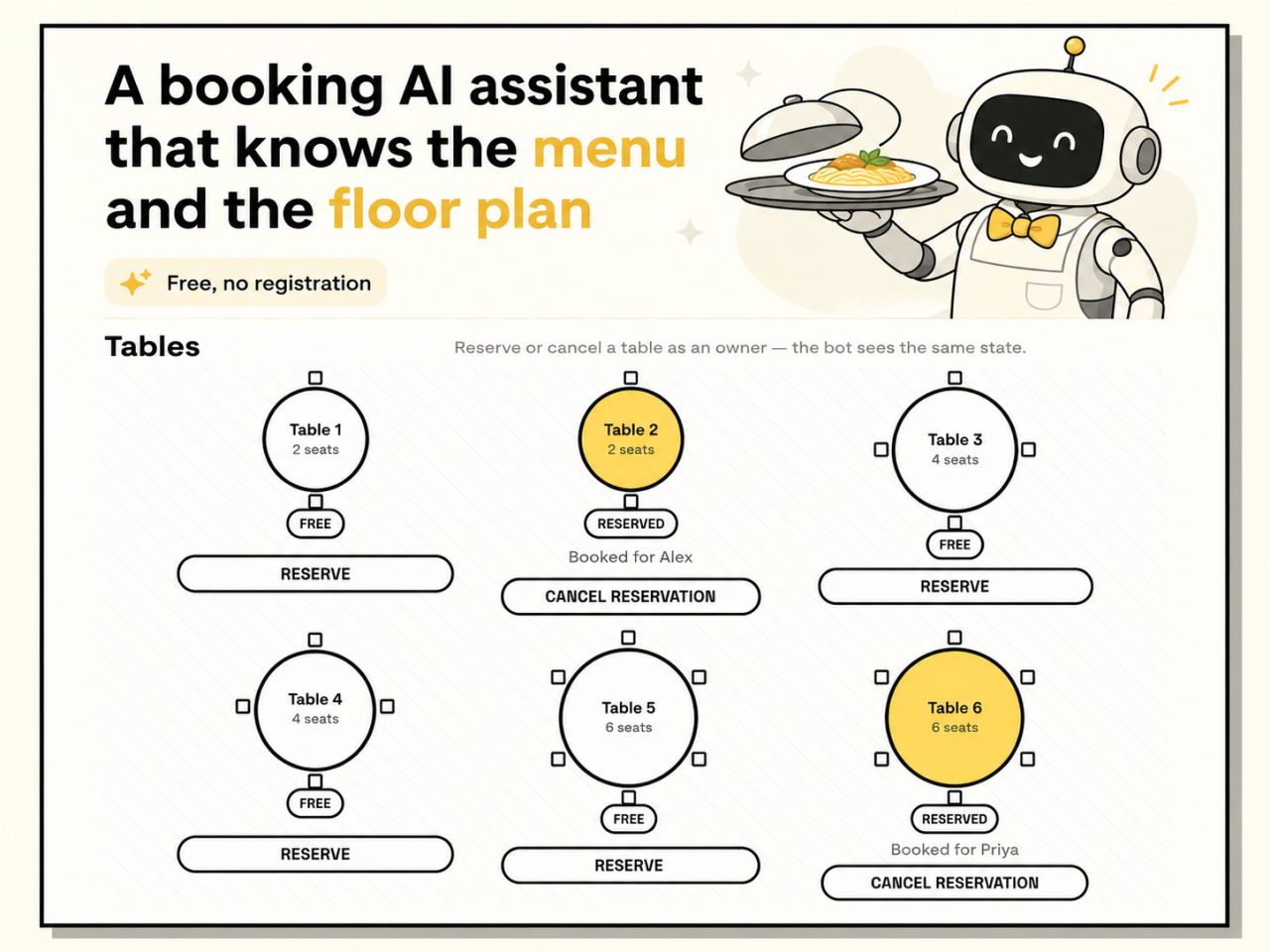
A Restaurant Booking Bot You Can Actually Try
A live demo of an AI restaurant assistant that knows the menu, the floor plan, and handles multi-part requests in one message — free, no registration.