
Sometimes automation is a product, not a workflow
Someone switched from Moneybird to Jortt for their small business and described the result: almost the entire bookkeeping process was now automated. Where automation wasn’t possible, the documentation explained how to handle it. They saved thousands per year on bookkeeping fees.
They didn’t build anything.
The automation came from the product design.
This is worth sitting with. When people talk about accounting automation, the conversation usually goes toward workflows, APIs, n8n, custom integrations. That’s the layer I work in. But for many small businesses, the right answer is a product that was designed with automation as a first principle — not a tool you automate on top of.
Jortt, Moneybird, some of the newer Dutch bookkeeping products — they make opinionated choices about how invoices flow, how bank transactions match, how VAT gets calculated. If your business fits within those choices, you get a lot of automation without writing anything.
If it doesn’t fit — because you have a custom pricing model, a non-standard payment processor, a multi-entity structure, a volume that overwhelms the native flow — that’s when the API layer matters and the workflow building starts.
Knowing which situation you’re in matters before you start spending time on custom solutions.
If a well-designed product handles 95% of your case, that’s worth more than a custom workflow that handles 100% but requires ongoing maintenance.
The automation that’s already built into the tool you use every day is easy to underestimate.
Until you switch to something without it.
Read next
Three nearby posts worth opening next.

Jun 1, 2026
When your bank and your bookkeeping are the same system
All-in-one bank plus bookkeeping removes the sync problem. It also changes what automation looks like — and what tradeoffs you're making without realizing it.

May 28, 2026
The tool is fine until your volume changes
A freelancer was happy with MoneyMonk until subscriptions meant more invoices and the lack of an API became a hard ceiling. Both founders replied in the thread.
May 31, 2026
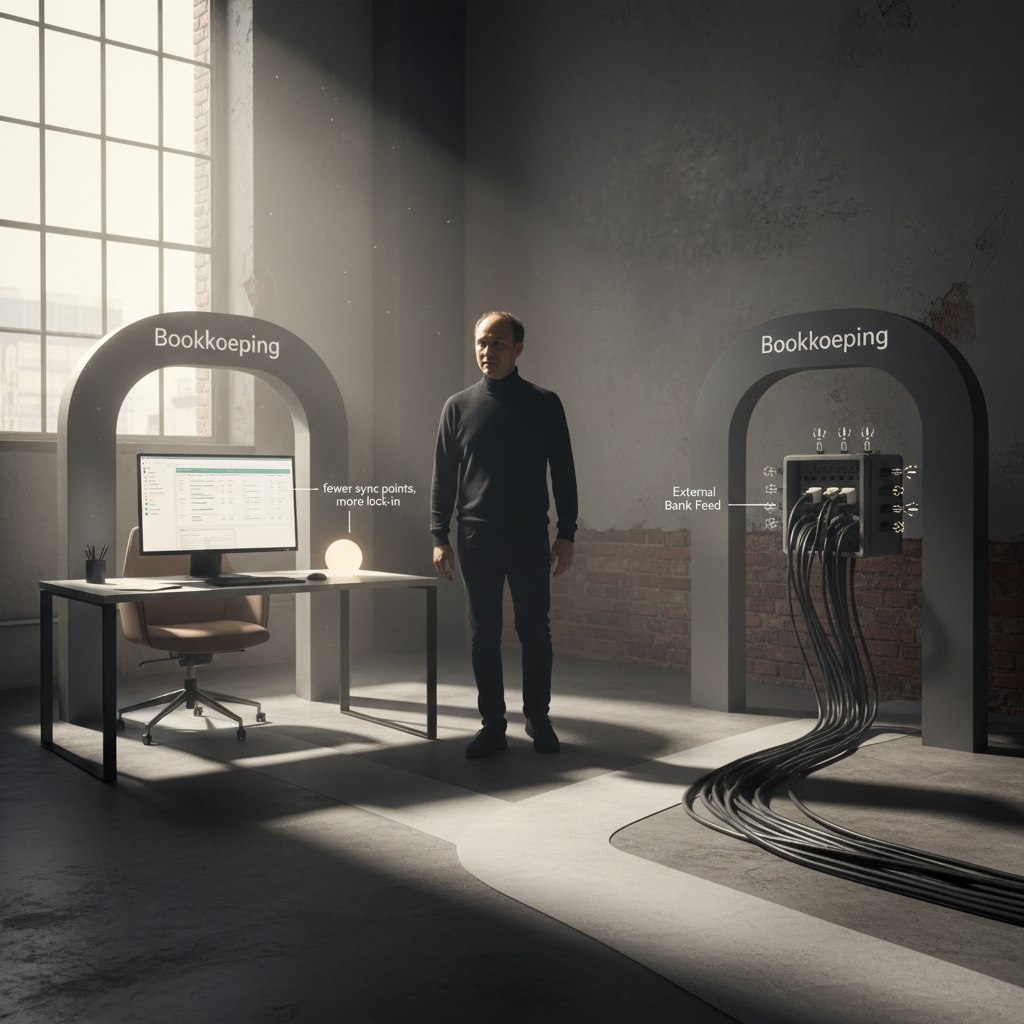
Your bank choice is also a bookkeeping decision
A starter asked whether to use Moneybird's own bank account or an external one. It sounds like a banking question — it's actually an automation one.